Can Radiologists Be Automated?
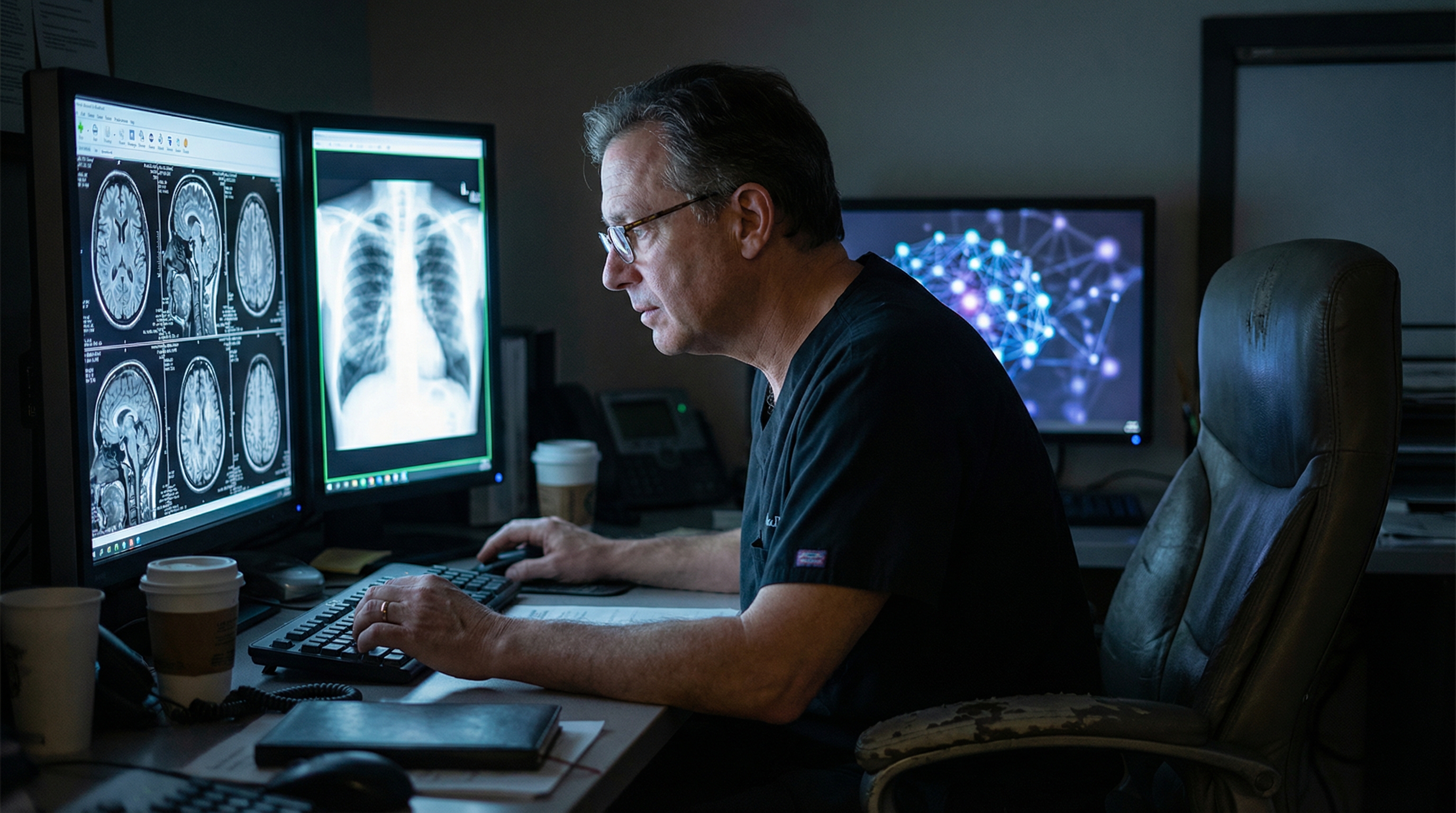
“Bill Gates believes doctors and teachers will be automated within 10 years.”
"All White collar jobs will be automated in 5 years"
Headlines like these are everywhere. You can’t scroll through a news feed without stumbling across another prediction about AI wiping out entire professions. But how much of this is actually true?
Remember when crypto was supposed to destroy the dollar? Or when sequencing the human genome was supposed to cure every disease in 5 years? Every tech wave comes with hype, underdelivers in the short term, and somehow still changes everything in the long run.
So it is now imperative, to ask what’s real and what’s just a talking point for TikTok views and Twitter hype
Radiology, specifically, has been "on the brink of automation" for years. Maybe because so much of the work is digital, like viewing, analyzing, and dictating reports, it feels ripe for takeover in a world where AI is supposed to take over everything done on a screen. If there are no procedures involved, why wouldn't radiology be one of the first to go?
Let’s start by clarifying what we mean when we say “AI in radiology.”
AI is thrown around so casually now that it’s become almost meaningless. Is it AI if it transcribes your voice dictation into a report? Is it AI if it rephrases the radiologist's read to make it sound cleaner?
Most people think of AI as just ChatGPT. Imagine you're a college student with an essay due. You pass the prompt to ChatGPT, it gives you a solid first draft, maybe 80 percent of the way there, and you finish the rest. The structure is there, the grammar is mostly right, and your job is to clean it up and make it sound like you.
That’s the benchmark we should use for radiology. Real automation would mean you upload imaging from any modality, the AI reviews the study, it generates a wet read, and the radiologist simply edits and finalizes it.
So how far away are we?
It’s tough to pin down an exact timeline. But we do know that some large hospital systems have already had success applying AI in limited ways.
For example, Northwestern’s hospital system uses AI to process full X-rays and CT scans, generating early reports.
New AI transforms radiology with speed, accuracy never seen before
The approach is fairly straightforward: feed large volumes of images alongside their corresponding reports into a neural network, and over time, it learns which visual features correspond to specific pathologies. With a large enough dataset, the results can be surprisingly accurate.
One major example is CheXpert, a dataset of over 200,000 chest radiographs from more than 65,000 patients at Stanford Medical Center. It has been used to train models like RadFound and Google’s ViT, which now outperform human radiologists in identifying certain pathologies, including pleural effusion, cardiomegaly, and pneumonia. Similar efforts have shown promise in detecting nodules on chest X-rays, tuberculosis, intracranial hemorrhages, and pulmonary embolisms.
Data is the Bottleneck
These breakthroughs mostly center on chest X-rays and CT scans. That’s not a coincidence. Chest X-rays are 2D and relatively simple for neural networks to process. CTs, while technically 3D, are composed of slices that follow consistent anatomical orientation. The protocols for CTs are also more standardized across facilities, which makes model training easier.
Most importantly, there’s a wealth of data available for these modalities. And that matters because AI models are data-hungry.
In contrast, other imaging modalities present major challenges. MRI scans vary significantly based on the scanner vendor, protocol, patient positioning, and imaging sequences. Ultrasounds are even more inconsistent, changing dramatically with the angle and pressure of the probe, even for the same study. Mammograms require higher resolutions and bring their own complexities. These factors make it difficult to build large, clean, and standardized datasets, without which AI models cannot train.
Even in CTs and chest X-rays, models only rival humans on a narrow set of pathologies, typically the ones with the most data.
We’re a long way from having a singular model that can handle the full scope of pathologies across an entire modality, let alone every modality.
Are radiologists safe?
For now, yes. There is no model that can fully automate any one modality end-to-end. The current systems are more like assistive tools, helping flag abnormalities and speeding up workflows in large hospital systems.
But that doesn’t mean automation is off the table forever. As compute continues to scale and big tech continues to invest heavily in aggregating medical imaging data, the gap will close. It’s not hard to imagine that in the next 15 years, an AI system can process an entire modality at human or above-human levels.
Of course, there are still major hurdles, from regulatory approval to questions of liability and trust. But there’s no denying the direction we are headed. The tools are improving, the datasets are growing, and the pressure to do more with less is only increasing. Full automation is not here yet, but it is no longer a question of if. It is a question of when.
Other Blogs
From Referral to Visit. And Everything In Between.
Powered by proprietary AI models purpose-built for medical documentation, healthcare workflows, with strict accuracy and security standards.